The Belfry CE VA Primary School
Maths
This area builds children's understanding of numbers, shapes, measures, and problem-solving skills.
At The Belfry, we use both Mastering Number and White Rose schemes of work alongside a range of practical resources. Children are taught maths through whole-class teaching, songs, video clips and games. We also use maths enhancement activities in the different areas of the classrooms, including the outdoors, which provide children with the opportunity to further explore and use their developing understanding of various mathematical concepts and relevant vocabulary.
Our aim is that all the children in Reception will develop a secure understanding of numbers, with the focus predominantly being numbers up to 10. Children learn to recognise smaller amounts without needing to count them (subitising) by seeing pictures and making arrangements with different amounts of objects. They begin to compare amounts in groups and learn relevant vocabulary to talk about what they observe. Hands-on activities engage the children and make it meaningful to them. Using cubes to build towers and familiar characters such as the Numberblocks supports their understanding.
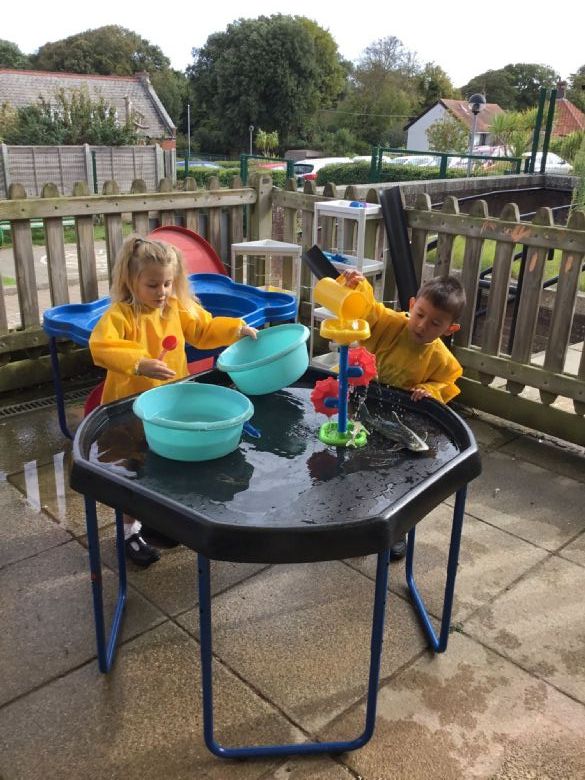
We also explore other mathematical concepts such as 2D and 3D shapes, naming them and describing their properties, and making arrangements and repeating patterns with them. The children are taught about measures, such as length and weight, and areas in the provision support them to explore these concepts, such as the craft table or sand/water area.
Early Learning Goals
Number
- Have a deep understanding of number to 10, including the composition of each number.
- Subitise (recognise quantities without counting) up to 5.
- Automatically recall (without reference to rhymes, counting or other aids) number bonds up to 5 (including subtraction facts) and some number bonds to 10, including double facts.
Numerical Pattern
- Verbally count beyond 20, recognising the pattern of the counting system.
- Compare quantities up to 10 in different contexts, recognising when one quantity is greater than, less than or the same as the other quantity.
- Explore and represent patterns within numbers up to 10, including evens and odds, double facts and how quantities can be distributed equally.