The Belfry CE VA Primary School
Literacy
This area focuses on fostering children's early reading and writing skills, including phonics, vocabulary, and comprehension.
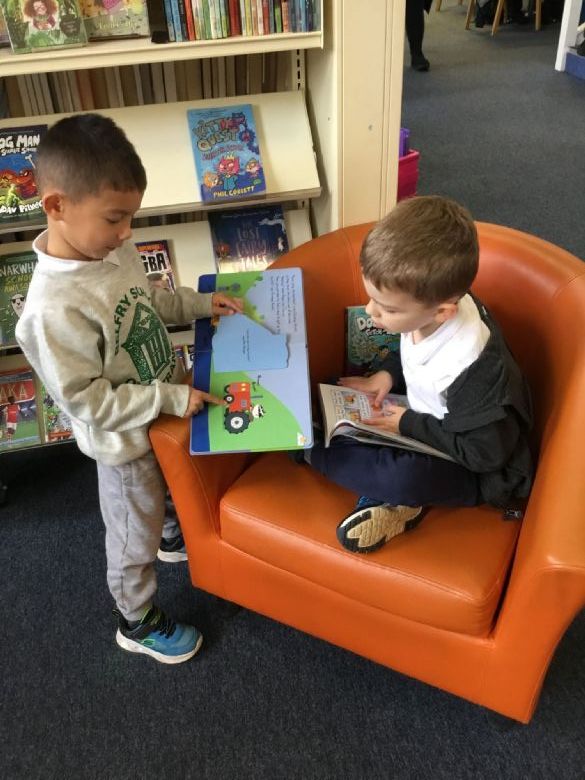
We recognise the value and impact that early engagement with books can have on children’s learning and achievement and aim to develop a love of books for all the children at our school. Staff use books to enhance all areas of the curriculum, reading stories from high quality, age-appropriate texts at every opportunity. These books are then used to enhance the learning environment and link to activities that are available.
At The Belfry, we follow a systematic approach to teaching phonics through a scheme called Little Wandle Letters and Sounds. Phonics lessons are taught daily and we provide intervention sessions to support children who need extra phonics catch-up. In addition to daily phonics, children are heard reading by an adult at least three times a week. They read a high quality, decodable book based on the phonics phase being taught (individually and as part of a guided reading group). Children are encouraged to take home an age-appropriate book from our classroom selection which they can share with their adult.
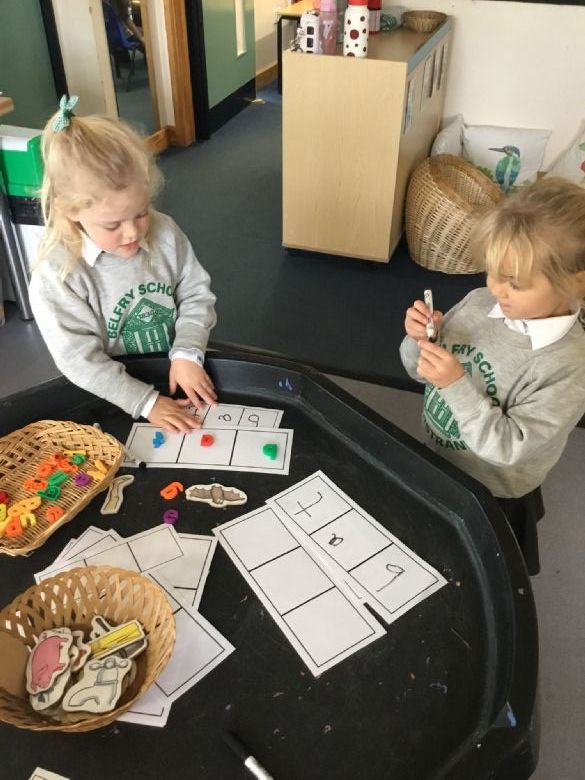
Children’s writing skills are supported as they progress through the phonics scheme: correct letter formation, spelling, sentence development and punctuation are explicitly taught by staff. Children are also encouraged to practice their writing skills during self-led play and are provided with writing resources including felt tip and gel pens, note pads, cards and envelopes, a range of pencils and other stationary. Fine motor activities are provided daily within the environment to support the children’s arm, hand and finger strength, vital for holding a pencil to write with.
Early Learning Goals
Comprehension
- Demonstrate understanding of what has been read to them by retelling stories and narratives using their own words and recently introduced vocabulary.
- Anticipate (where appropriate) key events in stories.
- Use and understand recently introduced vocabulary during discussions about stories, non-fiction, rhymes and poems and during role-play
Word Reading
- Say a sound for each letter in the alphabet and at least 10 digraphs.
- Read words consistent with their phonic knowledge by sound blending.
- Read aloud simple sentences and books that are consistent with their phonic knowledge, including some common exception words.
Writing
- Write recognisable letters, most of which are correctly formed.
- Spell words by identifying sounds in them and representing the sounds with a letter or letters.
- Write simple phrases and sentences that can be read by others.